
From observation to review
fscontext uses PROV- and RiC-O-oriented heuristics to
reconstruct filesystem contents, whether born-digital resources or
digital surrogates, into structures suitable for modern, standards-based
archival description. These default heuristics make it possible to
generate candidate contextual and provenance assertions efficiently, but
they do not substitute for data stewardship. The resulting
interpretations may still require correction, qualification, or
confirmation by a human reviewer.
Betwixt is named for the intermediate position it occupies in this
process. It provides intermediate relational representations between
automatically generated candidate assertions and their subsequent use as
stabilised semantic knowledge. These representations allow the results
of fscontext heuristics to be inspected and reproducibly
revised without making either the filesystem representation or the
review table itself the canonical knowledge representation.
fscontext deliberately separates observation from
interpretation. A filesystem scan records what was observed in a storage
context without determining the documentary or semantic identity of
those resources. Structural and contextual information derived from
those observations may then support later interpretation and semantic
stabilisation.
This vignette demonstrates the next step in that workflow. It uses
Betwixt to turn observational evidence and candidate assertions produced
with fscontext into bounded human-review tasks.
library(fscontext)
library(dplyr)
#> Warning: package 'dplyr' was built under R version 4.5.3
#>
#> Attaching package: 'dplyr'
#> The following objects are masked from 'package:stats':
#>
#>     filter, lag
#> The following objects are masked from 'package:base':
#>
#>     intersect, setdiff, setequal, union
library(fscontext)
library(tibble)
#> Warning: package 'tibble' was built under R version 4.5.2
From digital surrogates to heritage claims
A common cultural-heritage workflow begins not with an existing knowledge graph but with digital resources retrieved from a collection catalogue or repository. The following example uses three object records from the Estonian museum portal MuIS. Each catalogue page provides a thumbnail depicting a heritage object.
The review examples use the development version of Betwixt. The
Betwixt-dependent code is not evaluated when the fscontext
vignette is built.
# install.packages("pak")
pak::pak("dataobservatory-eu/betwixt")
review_input <- tibble::tribble(
  ~page_id, ~title, ~page_url, ~thumbnail_url, ~value,
  "635780", "sweater, women's",
  "https://www.muis.ee/museaalview/635780",
  "https://www.muis.ee/digitaalhoidla/api/meedia/pisipilt?id=ebc07930-f719-44f2-a108-6698bcecc20b",
  "sweaters",
  "633053", "gloves",
  "https://www.muis.ee/museaalview/633053",
  "https://www.muis.ee/digitaalhoidla/api/meedia/pisipilt?id=6440f24f-eaad-4cd4-84d7-1ae7a9d44d5a",
  "gloves",
  "635778", "shirt, women's",
  "https://www.muis.ee/museaalview/635778",
  "https://www.muis.ee/digitaalhoidla/api/meedia/pisipilt?id=826c402e-c130-4860-b11e-9538bd403ecf",
  "shirts"
)
The catalogue URLs identify the source records, but the images used as evidence are separate digital resources. We first download those resources into a temporary filesystem context.
image_dir <- file.path(tempdir(), "muis-images")
dir.create(image_dir, showWarnings = FALSE)

download_map <- tibble::tibble(
  thumbnail_url = review_input$thumbnail_url,
  filename = paste0(review_input$page_id, ".jpg"),
  local_path = file.path(
    image_dir,
    paste0(review_input$page_id, ".jpg")
  )
)

for (i in seq_along(download_map$thumbnail_url)) {
  download.file(
    url = download_map$thumbnail_url[i],
    destfile = download_map$local_path[i],
    mode = "wb",
    quiet = TRUE
  )
}

download_map
fscontext can now observe the downloaded resources as
filesystem evidence. The observation records their location within the
storage context and, with signature computation enabled, a lightweight
content signature. These are observational identifiers: they establish
which file was observed in this review workspace without asserting that
the local file is the canonical identity of the heritage object or of
every possible copy of the image. :contentReferenceoaicite:1
images <- fscontext::scan_storage(
  root = image_dir,
  storage_id = "muis-review",
  person_id = "reviewer",
  compute_signature = TRUE
)

images |>
  select(
    filename,
    storage_path_id,
    quick_sig
  )
The filesystem observations can be connected back to the MuIS records from which the images were obtained.
image_evidence <- images |>
  left_join(
    download_map,
    by = "filename"
  ) |>
  left_join(
    review_input |>
      select(
        page_id,
        title,
        page_url,
        thumbnail_url
      ),
    by = "thumbnail_url"
  )
This produces two distinct identities that should not be conflated: the observed digital resource identified in the filesystem context and the museum catalogue record identified by its MuIS URL. Their relationship is itself semantic material that can be reviewed.
Reviewing the digital resources
The first Betwixt projection reviews the relationship between the locally observed image and its source record.
resource_review <- betwixt::candidate_dataset(
  evidence_url = image_evidence$thumbnail_url,
  evidence_text = image_evidence$filename,
  label = image_evidence$filename,
  description = paste(
    "Downloaded from MuIS record",
    image_evidence$page_id
  ),
  subject = image_evidence$storage_path_id
) |>
  betwixt::add_candidate_column(
    value = image_evidence$page_url,
    definition = rep(
      "derived from source record",
      nrow(image_evidence)
    )
  )

resource_review
betwixt::betwixt_render(
  resource_review,
  cols = c(
    col_1 = "Digital resource",
    col_2 = "source record"
  ),
  title = "MuIS digital resource review",
  description = "Review the identity and source of each observed image.",
  project_id = "muis-example",
  filename_stem = "muis-resource-review",
  sequence = 0L,
  path = tempdir()
)

betwixt_review_1 <- readLines(
  con = file.path(tempdir(), "muis-resource-review.html")
)
writeLines(
  text = betwixt_review_1,
  con = file.path(here::here(),
                  "vignettes", "artefacts",
                  "muis-resource-review.html")
)
This review concerns the identity and source relationship of the observed evidence itself. It does not yet assert what the image depicts.
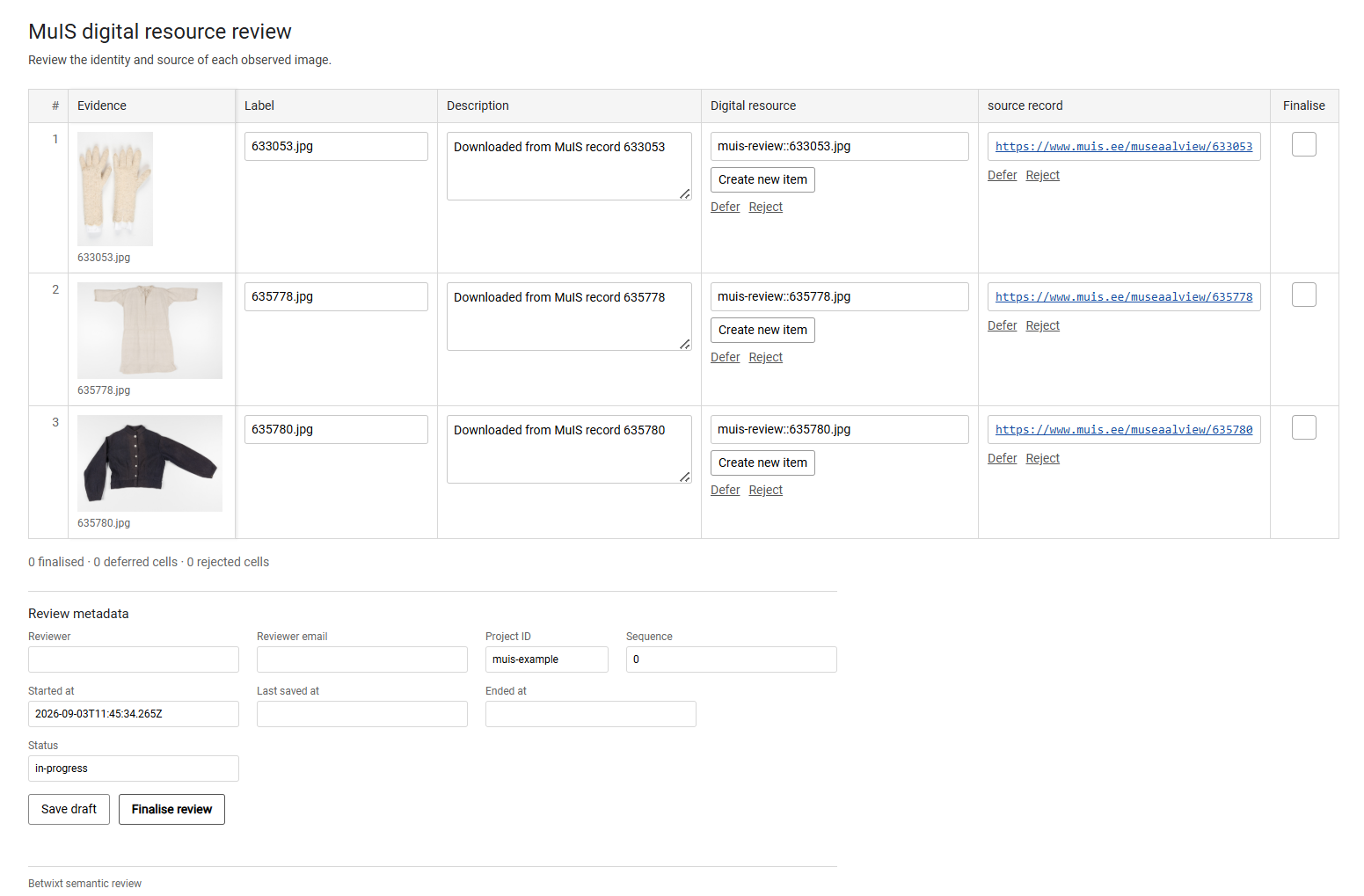
You can fill out the intermediate format, and save it as a draft, or
as a finalised, reviewed object. You can complete the review and save
the standalone HTML as a draft or as a finalised review. The saved
artefact retains the observational evidence supplied from
fscontext, the candidate semantic material presented for
review, and the resulting human review state and review metadata.
You can try it out by downloading the rendered example from here.
For a tutorial on how to use Betwixt, read Review Layouts.
Reviewing the heritage objects
A second projection uses the same evidence to review candidate knowledge about the heritage objects.
object_review <- betwixt::candidate_dataset(
  evidence_url = review_input$thumbnail_url,
  evidence_text = review_input$title,
  label = review_input$title,
  description = paste(
    "Heritage object described by MuIS record",
    review_input$page_id
  ),
  subject = review_input$page_url
) |>
  betwixt::add_candidate_column(
    value = review_input$value,
    range = candidate_range(
      "sweaters",
      "gloves",
      "shirts",
      "Other…"
    ),
    definition = rep(
      "object type",
      nrow(review_input)
    )
  )
betwixt::betwixt_render(
  object_review,
  cols = c(
    col_1 = "Heritage object",
    col_2 = "object type"
  ),
  title = "MuIS heritage object review",
  description = "Review the candidate classification of each heritage object.",
  project_id = "muis-example",
  filename_stem = "muis-object-review",
  sequence = 0L,
  path = tempdir()
)

betwixt_review_2 <- readLines(
  con = file.path(tempdir(), "muis-object-review.html")
)
The two reviews deliberately separate two questions. The first asks which digital resource was observed and from which museum record it was obtained. The second asks what can be asserted about the heritage object on the basis of that evidence.
writeLines(
  text = betwixt_review_2,
  con = file.path(here::here(),
                  "vignettes", "artefacts",  "muis-object-review.html")
)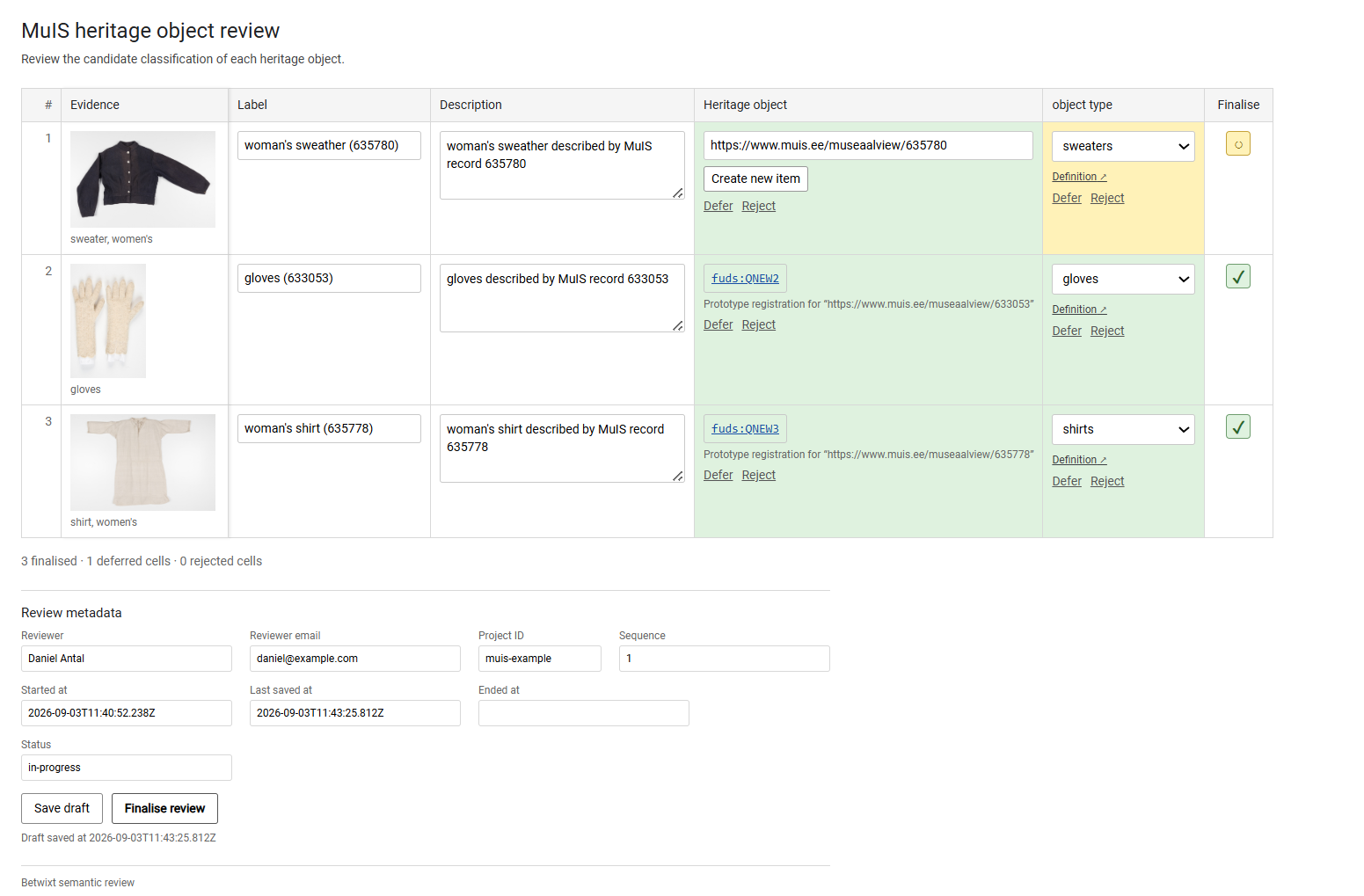
You can try out the second review by downloading the not yet reviewed version of the rendered html file from here.
From two reviews to a dual projection
Once both relationships have been sufficiently established, they can be joined into the dual representation developed earlier in this paper:
In wide form this would have the structure:
| Evidence | Relation | Subject | object type |
|---|---|---|---|
| observed image | depicts |
MuIS object 635780 | sweaters |
| observed image | depicts |
MuIS object 633053 | gloves |
| observed image | depicts |
MuIS object 635778 | shirts |
The example deliberately performs these as two separate reviews before combining their results. The identity and source of the digital evidence can therefore be reviewed independently from the classification of the heritage object. Once sufficiently stabilised, the reviewed relationships can provide the inputs to a subsequent dual projection.
Betwixt can also represent the evidence relation directly in a
dual-wide review. Here the two stages are kept separate to demonstrate
how an fscontext observation can first become reviewed
evidence and only subsequently participate in a further semantic
review.
The example also illustrates the complementary roles of
fscontext and Betwixt. fscontext observes and
identifies the digital resources encountered in a filesystem context
without prematurely identifying them with the heritage objects they
depict, while Betwixt turns the resulting candidate relationships into
bounded human-review tasks. The semantic connection between digital
evidence and heritage knowledge is therefore made explicit rather than
being hidden in the mechanics of downloading or displaying an image.
Relationship to the fscontext workflow
The example extends the observational workflow developed in the
preceding fscontext vignettes. scan_storage()
records the digital resources encountered in a storage context.
Structural and contextual operations can organise those observations
without treating the resulting structures as authoritative documentary
knowledge. Betwixt provides a downstream mechanism for exposing
candidate interpretations to human review.
The two packages therefore operate at different stages of the same workflow:
```text digital resources ↓ fscontext observation ↓ contextual organisation ↓ candidate semantic relationships ↓ Betwixt human review ↓ reviewed semantic material